Africa Solar Revolution — How Off-Grid Power Is Changing Nigeria and DR Congo
Africa's energy story is often told in terms of what the continent lacks. Nearly 600 million people across sub-Saharan Africa still have no access to reliable electricity. In Nigeria, despite being Africa's largest economy and a major oil producer, the national grid supplies less than 5,000 MW to a population of 220 million — roughly one-tenth of what South Africa generates for 60 million people. In the Democratic Republic of Congo, the electrification rate in rural areas hovers around 1%, even though the country possesses enough hydroelectric potential to power the entire continent.
But there is another story emerging — one defined not by deficit but by leapfrog. Just as mobile phones bypassed landlines across Africa in the 2000s, decentralized solar power is now bypassing the centralized grid. At Harutto Solar, we have been part of this transformation since we began operations in Nigeria and DR Congo, and the pace of change in 2026 is extraordinary.
This article examines how off-grid solar is reshaping communities in Nigeria and DR Congo, the technologies making it possible, and what Dubai's solar expertise brings to the African market.
Nigeria: Solar Mini-Grids and the Collapse of Generator Dependence
Nigeria's relationship with diesel and petrol generators is one of the defining economic burdens of the 21st century. The country's estimated 22 million small generators consume $14 billion in fuel annually, produce terrible air pollution, and still deliver unreliable power. For businesses, generator costs can represent 40-60% of operating expenses. For households, the noise, fumes, and fuel costs are a daily hardship.
Solar mini-grids are changing this equation rapidly. A mini-grid is a localized power system — typically 10-500 kW — that serves a defined community or industrial area without connection to the national transmission network. In Nigeria, the Rural Electrification Agency (REA) has deployed over 100 solar mini-grids since 2023, and private developers have added several hundred more. The Nigerian Electricity Regulatory Commission (NERC) established a formal mini-grid regulatory framework in 2024, giving developers clarity on tariffs, licensing, and grid interconnection rules.
Harutto Solar has completed mini-grid projects in Lagos State and Rivers State, serving agricultural processing facilities and rural communities. Our approach applies the same engineering standards we use in Dubai — Tier-1 components, proper earthing and surge protection, remote monitoring — adapted for local conditions. The difference is not in quality but in logistics: shipping panels to Port Harcourt, transporting equipment on roads that flood during rainy season, and training local technicians who will maintain the systems for decades.
The impact is measurable. A 50 kW solar mini-grid serving a community of 500 households in Rivers State eliminates approximately 200 small generators, saving the community an estimated $150,000 per year in fuel costs while providing cleaner, more reliable power. Children study under electric light. Clinics refrigerate vaccines. Small businesses operate welding machines and refrigeration units that were previously impossible.
DR Congo: Containerized Solar for Mining and Humanitarian Operations
The Democratic Republic of Congo presents a different challenge. The country's vast size, minimal road infrastructure, and ongoing security concerns in eastern provinces make traditional grid extension impractical for the foreseeable future. Yet the economic activity is enormous — DRC produces 70% of the world's cobalt, a critical mineral for electric vehicle batteries and solar storage systems.
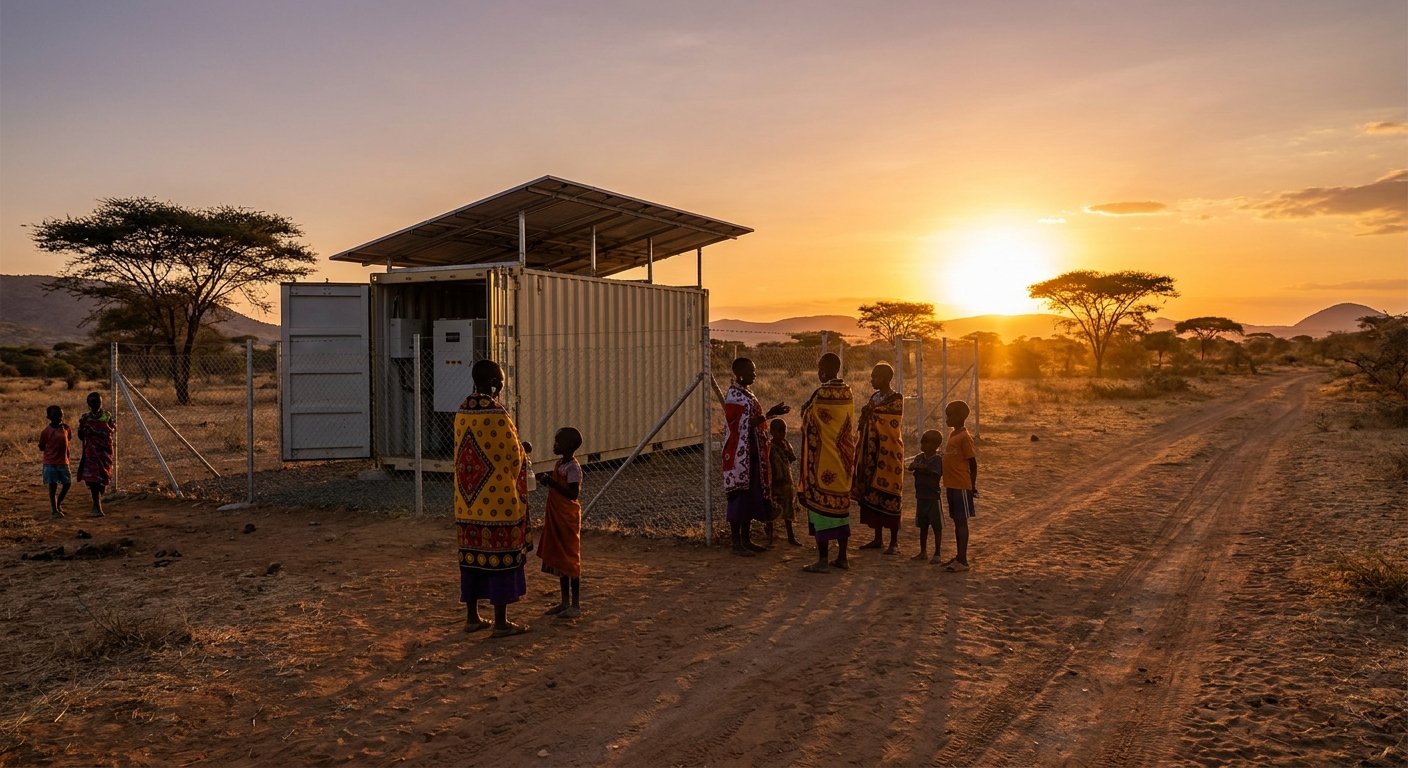
Mining operations in Katanga and Kasai regions have historically relied on diesel generators, but the economics are shifting. A containerized solar system — a complete power plant built inside a standard 20-foot or 40-foot shipping container — can be transported by truck or barge, deployed in days, and operational within a week. These systems typically include 100-500 kW of solar panels, 200-1,000 kWh of battery storage, and a diesel generator as backup for extended cloudy periods.
Harutto Solar has supplied containerized solar systems to mining support camps and humanitarian operations in eastern DRC. The humanitarian sector is a significant and often overlooked market: UN agencies, WHO field offices, and NGOs operating in conflict zones need reliable power for medical facilities, water purification, and communications. Solar containerized systems reduce their diesel supply chain — which is both expensive and dangerous to transport in active conflict zones — by 60-80%.
The technical challenge in DRC is not the solar resource, which is excellent near the equator, but the operating environment. High humidity, dust, and limited local technical capacity mean that systems must be over-engineered for reliability. We specify IP65-rated enclosures, stainless steel mounting hardware, and remote monitoring systems that allow our Dubai-based team to diagnose issues without dispatching a technician.
The Technology Making It Possible
Three technology trends are accelerating Africa's solar revolution in 2026.
First, the continued decline in solar panel prices. At under $0.15 per watt for Tier-1 monocrystalline modules, the capital cost of solar generation has reached a point where it is cheaper than any fossil fuel alternative in most African markets, even before accounting for fuel price volatility.
Second, the maturation of pay-as-you-go (PAYG) solar home systems. Companies like d.light, Greenlight Planet, and Azuri Technologies have deployed millions of small solar systems (10-100W) across Africa, financed through mobile money platforms. A household in rural Kenya or Nigeria can purchase a solar home system for as little as $5 per month via M-Pesa or MTN Mobile Money, paying it off over 12-24 months. This model has made solar accessible to populations that could never afford an upfront purchase.
Third, remote monitoring and IoT-enabled system management. Modern solar installations in Africa are equipped with cellular-connected monitoring platforms that track generation, consumption, battery health, and fault conditions in real time. This allows operators in Dubai or Lagos to manage hundreds of distributed systems without physical visits, dramatically reducing operational costs and improving system uptime.
What Dubai Brings to Africa's Solar Market
The UAE's investment in solar expertise over the past decade has created a deep pool of engineering and project management capability. Dubai's Shams Dhabi program alone has driven the installation of over 700 MW of distributed solar, creating a workforce of DEWA-approved contractors who understand grid-tied design, net-metering compliance, and large-scale EPC execution.
Harutto Solar brings this capability to Africa. Our team includes engineers who have worked on projects ranging from residential villas in Dubai to industrial solar farms in Jebel Ali, and we apply the same standards to our African projects. The engineering principles are identical — proper system sizing, quality components, code-compliant installation, and long-term maintenance planning.
What we have learned is that success in Africa requires more than technical excellence. It requires understanding local supply chains, navigating regulatory environments that are still maturing, training local workforces, and building relationships with community leaders and government officials. We invest in all of these because we believe Africa's energy transition is not a short-term project but a generational opportunity.
Key Takeaways
- 600 million people in sub-Saharan Africa lack reliable electricity, creating enormous demand for decentralized solar solutions
- Nigeria's solar mini-grid sector is growing rapidly, supported by a formal regulatory framework from NERC and deployment by the Rural Electrification Agency
- DR Congo's mining and humanitarian sectors are adopting containerized solar systems to reduce diesel dependence in remote, challenging environments
- Pay-as-you-go solar home systems, financed through mobile money, have made solar accessible to low-income households across Africa
- Remote monitoring and IoT platforms allow operators to manage distributed solar assets across multiple countries from a single control center
- Dubai's solar EPC expertise, developed through programs like Shams Dubai, is directly transferable to African markets
Frequently Asked Questions
Does Harutto Solar install residential solar systems in Africa?
Our primary focus in Africa is commercial, industrial, and community-scale projects — mini-grids, containerized systems, and mining or humanitarian installations. For residential inquiries, we connect clients with our local partner networks in Nigeria, DR Congo, Kenya, and Egypt.
How do you handle maintenance for solar systems in remote African locations?
All our installations include remote monitoring via cellular connectivity, allowing our Dubai-based team to diagnose issues in real time. We train local technicians during commissioning and maintain spare parts inventories in regional hubs in Lagos and Kinshasa. For critical systems, we offer annual maintenance contracts with guaranteed response times.
What is the typical payback period for a solar mini-grid in Nigeria?
For a well-designed 50-100 kW mini-grid serving a commercial or community load, payback typically ranges from 3-5 years, depending on the tariff structure and the cost of the diesel generation it replaces. The REA and several development finance institutions offer concessional financing that can improve project economics further.
Can containerized solar systems operate in extreme heat and humidity?
Yes. Our containerized systems are engineered for ambient temperatures up to 50°C and relative humidity up to 95%. We specify IP65-rated enclosures, forced-air ventilation with filtered intakes, and stainless steel or aluminum mounting hardware to resist corrosion. These systems are designed for 20-year operational life in harsh environments.