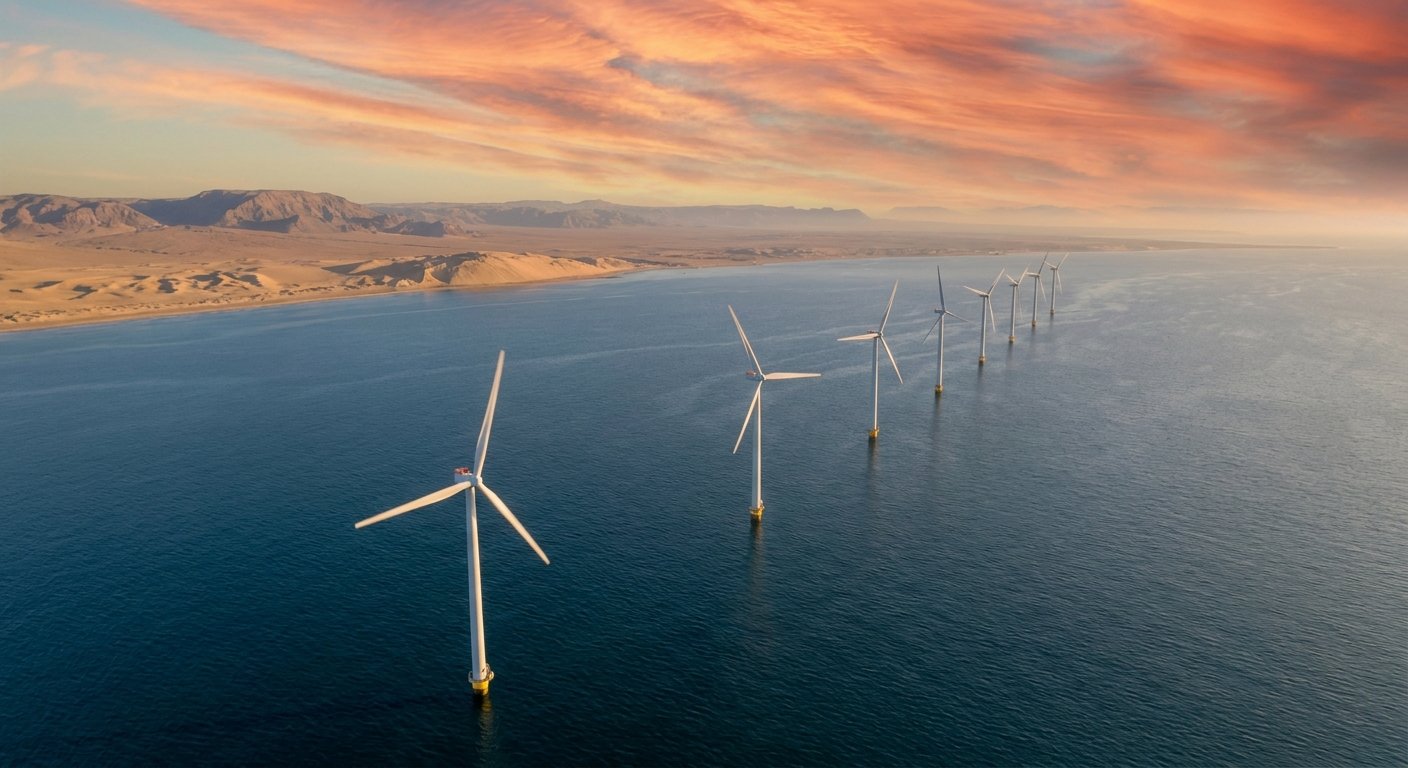
When most people in the UAE think about renewable energy, they think about solar. The logic is obvious — 350 sunny days per year, vast open desert, and a government that has made solar a national priority through initiatives like Shams Dubai and the Mohammed bin Rashid Al Maktoum Solar Park. But there is another renewable resource blowing steadily across the Arabian Gulf that the region has barely begun to tap: offshore wind.
In April 2026, the conversation around wind energy in the Middle East has shifted from theoretical to practical. The UAE's own energy planners have identified over 400 gigawatts of technically feasible offshore wind capacity in the Arabian Gulf and Gulf of Oman. To put that number in perspective, the entire UAE currently generates about 40 GW from all sources combined. The wind resource alone could theoretically power the country ten times over.
At Harutto Solar, we see wind not as a competitor to solar but as a complement. Understanding how these two technologies work together is essential for anyone planning long-term energy strategy in the region.
The UAE's Wind Resource: Better Than You Think
The Arabian Gulf's wind profile is fundamentally different from the North Sea, where offshore wind first became commercially viable. Gulf winds are moderate by European standards — average speeds of 5-7 meters per second compared to 8-10 m/s in the North Sea. However, modern turbine technology has advanced significantly. The latest generation of turbines from Vestas, Siemens Gamesa, and Goldwind are designed to generate efficiently at lower wind speeds, making Gulf conditions increasingly viable.
The real advantage of offshore wind in the UAE is its generation profile. Solar panels produce nothing at night and peak at midday. Wind speeds in the Arabian Gulf tend to be strongest during evening and early morning hours, driven by temperature differentials between the sea and the desert. This complementary pattern means that a combined solar-wind system delivers a more consistent power output across the 24-hour cycle, reducing reliance on battery storage or grid backup.
The UAE's National Energy Plan, updated in late 2025, explicitly references offshore wind as a "strategic option for the 2035-2050 period." DEWA's research division has been collecting offshore wind data from met masts installed near Ras Al Khaimah and Abu Dhabi since 2023. Early data confirms that capacity factors of 28-35% are achievable — lower than the North Sea's 40-50%, but competitive with solar on a levelized cost basis when accounting for the complementary generation timing.
Global Offshore Wind Lessons for the Gulf
The global offshore wind industry has matured rapidly. Total installed capacity exceeded 80 GW by the end of 2025, with China, the UK, and Germany leading deployment. The cost of offshore wind has fallen by 60% since 2015, reaching parity with natural gas generation in several markets. These cost reductions come from larger turbines (now 15-18 MW per unit), standardized foundation designs, and streamlined installation vessels and procedures.
For the UAE, the most relevant precedent is Saudi Arabia's NEOM project, which announced in 2025 that it would develop 2 GW of offshore wind in the Red Sea as part of its zero-carbon city vision. The Red Sea's wind conditions are comparable to the Arabian Gulf, and NEOM's procurement process has already attracted bids from major European and Chinese turbine manufacturers. If NEOM's project proceeds on schedule, it will serve as a proof of concept for the entire Gulf region.
The UAE also benefits from its existing maritime and oil and gas infrastructure. The same ports, heavy-lift vessels, and offshore engineering expertise that serve ADNOC's offshore oil operations can be repurposed for wind turbine installation. Companies like Lamprell, based in Sharjah, have already begun diversifying into offshore wind foundation manufacturing.
Hybrid Solar-Wind Systems: The Practical Opportunity
For commercial and industrial energy consumers in Dubai, the most immediate opportunity is not utility-scale offshore wind — that is still years away — but hybrid on-site systems that combine rooftop solar with small-scale wind turbines. While large offshore turbines require government-level investment and grid infrastructure, smaller vertical-axis and horizontal-axis wind turbines (1-100 kW) can be installed on-site alongside solar panels.
Harutto Solar has been evaluating hybrid configurations for warehouse and factory clients in Dubai Industrial City and Jebel Ali Free Zone. A typical setup pairs a 100kWp rooftop solar array with two 10kW wind turbines mounted on the building's parapet or on adjacent ground-mounted towers. During the summer months, when air conditioning loads peak and solar output is slightly reduced by extreme heat, the wind component provides meaningful supplementary generation during evening hours when demand remains high.
The economics are still developing. Small wind turbines in urban environments face turbulence from surrounding buildings, which reduces output and increases mechanical wear. But for sites with clear exposure — coastal properties, open industrial plots, and rural facilities — the combination of solar and wind can reduce payback periods by 6-12 months compared to solar alone.
Challenges and Realistic Timelines
Offshore wind in the UAE faces real hurdles that should not be minimized. The Arabian Gulf is shallow, which is good for fixed-foundation turbines, but it is also busy with shipping traffic, oil and gas operations, and military activity. Designating wind farm zones requires coordination across multiple government agencies. Environmental assessments are needed to understand impacts on marine ecosystems, particularly coral reefs and dugong populations.
Grid integration is another consideration. The UAE's transmission network was designed around large centralized power plants, not distributed renewable generation. Integrating variable wind power requires grid upgrades, smart inverters, and potentially grid-scale battery storage — all of which are underway but not yet complete.
Realistically, the first commercial offshore wind project in the UAE will not be operational before 2032-2035. But the planning, environmental studies, and procurement processes need to start now. For businesses and property owners, the takeaway is that wind energy will become part of the UAE's energy mix within the next decade, and designing solar systems today with future hybrid compatibility is a smart long-term decision.
Key Takeaways
- The UAE has an estimated 400 GW of technically feasible offshore wind capacity in the Arabian Gulf and Gulf of Oman
- Wind generation complements solar because Gulf winds peak during evening and early morning hours when solar output is zero
- Saudi Arabia's NEOM 2 GW offshore wind project is the most relevant regional precedent and is expected to demonstrate Gulf viability
- On-site hybrid solar-wind systems are available now for commercial and industrial properties with suitable wind exposure
- Utility-scale offshore wind in the UAE is realistically 6-10 years away, but planning and environmental studies are underway
- The UAE's existing offshore oil and gas infrastructure and expertise can be repurposed for wind energy deployment
Frequently Asked Questions
Is offshore wind viable in the UAE given that wind speeds are lower than in Europe?
Yes, with caveats. Average wind speeds in the Arabian Gulf are 5-7 m/s, lower than the North Sea's 8-10 m/s. However, modern turbines are designed to operate efficiently at these speeds. Capacity factors of 28-35% are achievable, which is commercially viable, especially given the complementary timing with solar generation.
Can I install wind turbines on my property in Dubai alongside solar panels?
For commercial and industrial properties with adequate space and wind exposure, yes. Small-scale wind turbines (1-100 kW) can be integrated with rooftop solar to create hybrid systems. Residential installations in dense urban areas are generally not practical due to building turbulence and permitting restrictions. Contact Harutto Solar for a site-specific assessment.
When will the UAE have utility-scale offshore wind farms?
Based on current government planning and regional precedents, the first commercial offshore wind projects in the UAE are expected between 2032 and 2035. Environmental studies, grid infrastructure upgrades, and zone designation are the critical path items that need to happen first.
How does wind energy fit with Shams Dubai net-metering?
Currently, Shams Dubai applies to solar PV systems. DEWA has not yet extended net-metering to wind generation, but industry observers expect the framework to be updated as wind technology becomes more prevalent. Any grid-connected renewable system must be approved by DEWA regardless of technology type.