The solar industry is standing at the edge of a transformation that many engineers have waited decades to see. In early 2026, perovskite-silicon tandem solar cells crossed the 33.7% efficiency barrier in laboratory settings, surpassing the theoretical practical limit of traditional silicon panels that have dominated rooftops across Dubai and the wider UAE for the past two decades. For property owners evaluating solar investments today, this raises an important question: should you buy now, or wait for the next generation?
At Harutto Solar, we field this question regularly from villa owners in Emirates Hills, warehouse operators in Jebel Ali, and facility managers across DAFZA. The answer is not straightforward, but understanding the technology helps you make a sound financial decision. This article breaks down where perovskite technology stands today, what it means for the Dubai market, and how to think about timing your solar investment.
What Are Perovskite Solar Cells?
Perovskite is a class of synthetic materials that share a specific crystal structure, named after the mineral calcium titanite. When engineered at the nanoscale, these materials are exceptionally good at absorbing sunlight and converting it into electricity. The key advantage is that perovskites can be manufactured using low-cost chemical processes — essentially printed or coated onto surfaces — unlike silicon cells that require energy-intensive purification and wafer cutting.
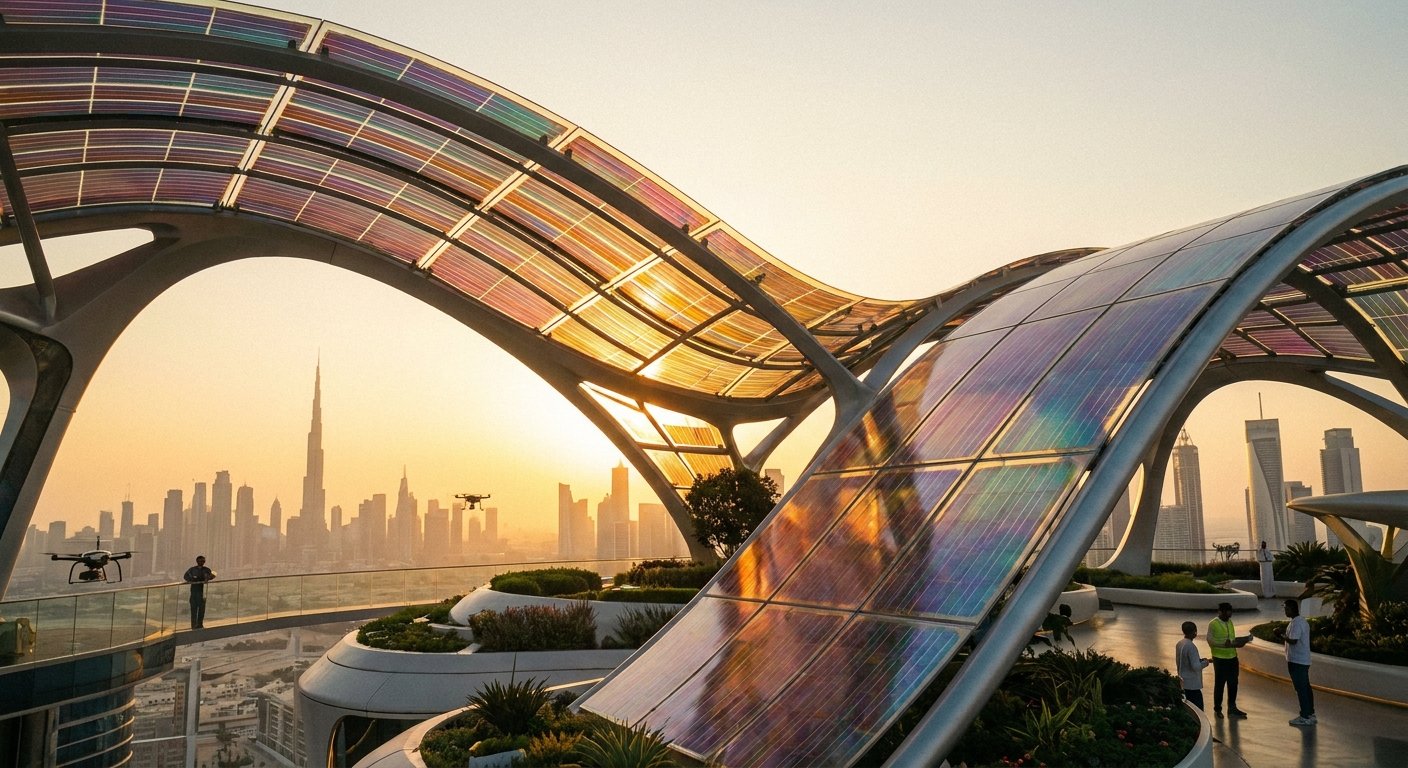
The real breakthrough in 2026 is not perovskite alone, but the tandem approach. Engineers layer a perovskite cell on top of a conventional silicon cell. The perovskite layer captures blue and green wavelengths of light, while the silicon layer captures red and infrared. Together, they extract significantly more energy from the same sunlight than either material can achieve independently. Oxford PV, a UK-based manufacturer, reported a certified 33.7% efficiency for its perovskite-silicon tandem cell in January 2026, up from 29.5% just two years ago.
For context, the standard Tier-1 monocrystalline panels we install on Dubai rooftops today operate at 21-23% efficiency. That means tandem cells produce roughly 40-50% more power from the same roof area.
Where the Technology Stands in 2026
Despite the impressive lab numbers, perovskite tandem panels are not yet available for residential or commercial installation in the UAE. The primary obstacle is durability. Perovskite materials degrade when exposed to moisture, heat, and prolonged UV radiation — three conditions that define the Dubai climate for eight months of the year. Current encapsulation techniques extend panel lifespan to approximately 10-12 years, compared to the 25-30 year warranties offered by silicon manufacturers like LONGi, JA Solar, and Canadian Solar.
Several manufacturers are racing to close this gap. Hanwha Q Cells, a major supplier in the Gulf market, has announced plans to begin pilot production of tandem panels by Q4 2026. Chinese manufacturer Microquanta has already shipped small commercial batches in mainland China, targeting indoor and low-irradiation applications first. The UAE's own Masdar Institute has been running accelerated aging tests on perovskite samples in Abu Dhabi's outdoor conditions since 2024, and their preliminary data suggests that next-generation encapsulation could achieve 20-year stability by 2028.
The pricing trajectory follows a familiar pattern. When silicon panels first entered mass production in the early 2000s, they cost over $4 per watt. Today, they sell for under $0.15 per watt. Perovskite tandems are expected to follow a similar curve, but the timeline for cost parity with silicon is still 3-5 years away.
What This Means for Dubai Rooftop Solar
Dubai's solar economics are already compelling without perovskite. Under the Shams Dubai net-metering program, a typical 10kWp residential system installed by a DEWA-approved contractor like Harutto Solar costs between AED 28,000 and AED 42,000 and achieves payback in 3.5 to 5 years. DEWA's net-metering credits offset electricity bills at the full retail rate, making every exported kilowatt-hour directly valuable.
If you wait for perovskite panels, you are forgoing 3-5 years of those savings. A villa owner who delays installation until 2029 loses approximately AED 15,000-25,000 in avoided electricity bills and DEWA credits. Even if tandem panels eventually deliver 40% more output per square meter, the financial math still favors installing proven silicon systems today.
Where perovskite will matter first in Dubai is in space-constrained commercial installations. Warehouses and factories with limited roof area but high energy demand will benefit enormously from higher efficiency per square meter. A 500kWp commercial system that currently needs 2,500 square meters of roof could potentially fit into 1,700 square meters with tandem panels, unlocking solar for buildings that today cannot generate enough power from their available roof space.
The Hybrid Future: Solar Plus Storage Plus Smarter Panels
The most realistic near-term scenario for Dubai is not perovskite replacing silicon, but a layered technology ecosystem. High-efficiency silicon panels remain the workhorse. Battery storage — which we are already installing alongside Shams Dubai systems — handles evening demand. And when perovskite tandems become commercially viable and climate-tested for Gulf conditions, they will be added as a premium option for new builds and retrofit projects where roof space is at a premium.
The UAE's Energy Strategy 2050 targets 44% clean energy in the total mix. Achieving this requires every available technology to contribute. Perovskite will be part of that mix, but it is a complement to today's silicon infrastructure, not a replacement for it.
At Harutto Solar, we monitor these developments continuously so we can advise our clients accurately. The best solar investment is one that matches proven technology to your specific roof, your energy consumption, and your financial timeline.
Key Takeaways
- Perovskite-silicon tandem cells achieved 33.7% efficiency in lab tests in early 2026, a record for commercially relevant photovoltaic technology
- These panels are not yet available for installation in the UAE; commercial availability is expected late 2027 at the earliest
- Durability in hot, humid, high-UV environments like Dubai remains the primary engineering challenge
- Waiting to install solar means losing years of DEWA net-metering credits — the financial math favors installing proven silicon panels today
- Perovskite will first benefit space-constrained commercial rooftops where higher efficiency per square meter unlocks projects that are not viable with current panels
- The UAE's Masdar Institute is actively testing perovskite durability in local outdoor conditions
Frequently Asked Questions
Can I install perovskite solar panels on my Dubai villa today?
No. Perovskite-silicon tandem panels are not yet commercially available for residential installation anywhere in the world. Pilot production is expected to begin in late 2026, with Gulf market availability likely in 2028 or later. If you want solar savings now, proven silicon panels from Tier-1 manufacturers are the right choice.
Are perovskite panels better than the panels Harutto Solar installs?
In laboratory conditions, yes — they convert more sunlight into electricity per square meter. But they have not yet been proven to survive 25 years in Dubai's extreme heat and humidity. The silicon panels we install today come with 25-year performance warranties and have a proven track record in the Gulf climate.
Should I wait for perovskite panels before going solar?
From a financial perspective, no. Every year without solar is a year of full electricity bills and missed DEWA net-metering credits. A typical Dubai villa loses AED 4,000-6,000 per year by waiting. Even when perovskite panels arrive, the savings you forfeit by waiting will likely exceed the efficiency gain.
Will Harutto Solar offer perovskite panels when they become available?
Yes. We continuously evaluate new technology and will offer perovskite tandem panels as soon as they meet our standards for durability, warranty, and performance in UAE conditions. Our clients who install silicon systems today will be first in line for upgrade consultations when new technology arrives.