
Solar Battery Storage 2026 — Why Dubai Homeowners Are Going Hybrid
Something shifted in the Dubai solar market in early 2026. For the first time since Harutto Solar began installing grid-tied systems under the Shams Dubai program, battery storage has moved from a niche add-on to a standard recommendation. The reason is simple economics: battery prices have fallen 40% since mid-2024, and DEWA's time-of-use tariff structure now makes stored solar energy genuinely valuable for homeowners.
If you installed a solar system in Dubai two or three years ago without batteries, you are likely exporting surplus midday power back to the grid at the standard DEWA credit rate. That is fine. But a homeowner who adds battery storage today can store that surplus instead and use it during the evening peak period when electricity rates are highest. The financial difference is significant — and it is changing how we design systems for our clients.
This article explains the battery technologies available in 2026, how they integrate with existing Shams Dubai installations, and what the actual payback looks like for a typical Dubai villa.
Battery Technology in 2026: What Has Changed
The dominant battery chemistry for residential solar storage has shifted decisively from lithium nickel manganese cobalt oxide (NMC) to lithium iron phosphate (LFP). LFP batteries are safer, last longer, and contain no cobalt — addressing both supply chain and safety concerns. For Dubai's climate, the safety advantage is particularly relevant. LFP cells are thermally stable up to 270°C and do not readily enter thermal runaway, even in the extreme ambient temperatures that garage-mounted battery enclosures can reach during July and August.
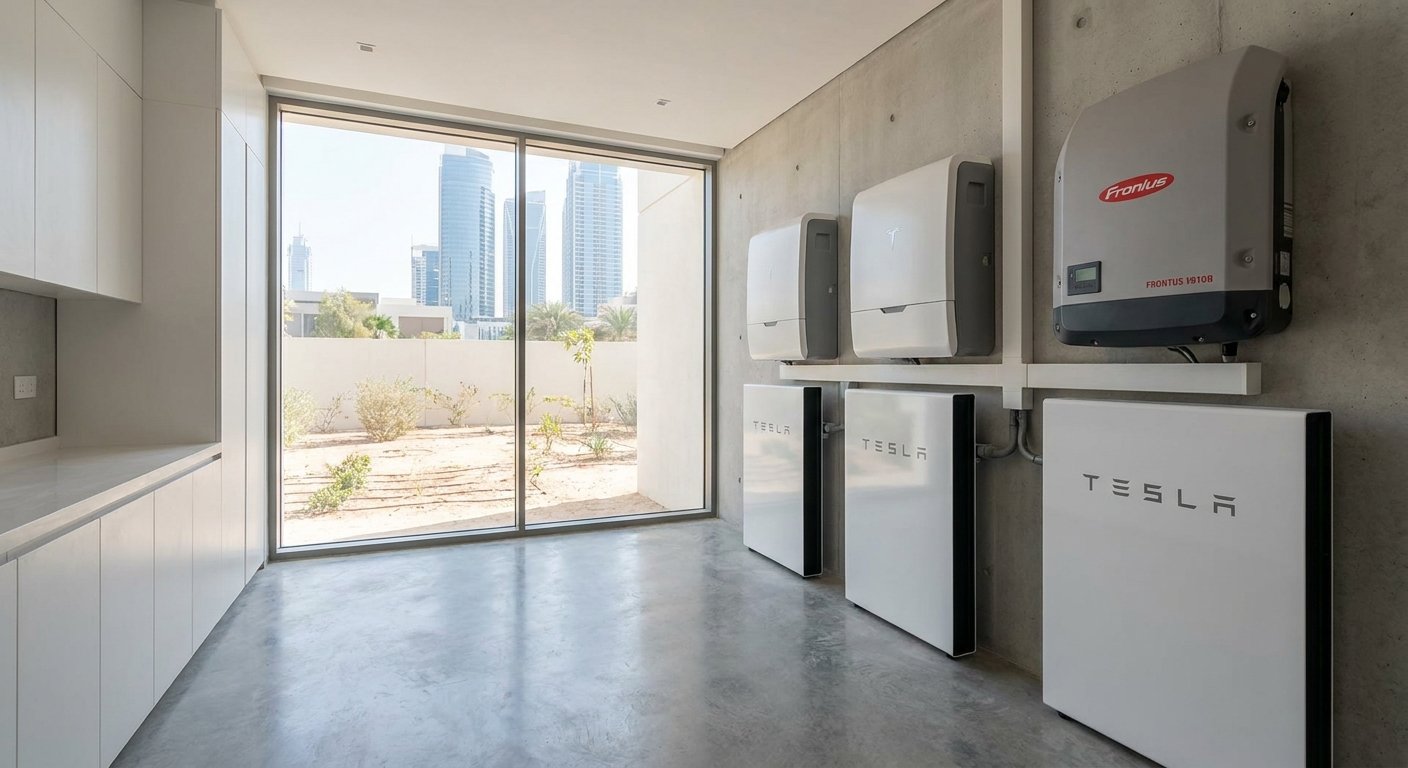
The leading products in the UAE market in 2026 include the Huawei LUNA2000 (5-30 kWh modular), the BYD Battery-Box Premium (5.1-32.6 kWh), and the Tesla Powerwall 3 (13.5 kWh). All three are LFP-based, carry 10-year warranties, and are rated for outdoor installation in ambient temperatures up to 50°C. Round-trip efficiency — the percentage of stored energy you actually get back — has improved to 94-97%, meaning very little is lost in the charge-discharge cycle.
The most significant change is cost. In mid-2024, a 10 kWh residential battery system installed in Dubai cost AED 18,000-22,000. By May 2026, that same capacity costs AED 11,000-14,000 installed, including the inverter interface and commissioning. This price drop is driven by massive overproduction of LFP cells in China, where CATL, BYD, and EVE Energy have all expanded production capacity faster than global demand has grown.
How Batteries Work with Shams Dubai
Shams Dubai is DEWA's net-metering program, which allows solar system owners to export surplus generation to the grid and receive credits on their electricity bill. When you add battery storage, the system logic changes: instead of exporting all surplus midday power, the battery charges first, and only excess beyond the battery's capacity goes to the grid.
During the evening — typically 6 PM to 11 PM — the battery discharges to power the home, reducing or eliminating grid consumption during DEWA's peak tariff period. Any remaining battery capacity at the end of the night charges from the grid at off-peak rates (if the homeowner has opted for time-of-use billing) or simply stays full for the next day.
The key financial benefit is the differential between what DEWA credits you for exported solar (the standard retail rate) and what you avoid paying for evening grid consumption (the peak rate). In 2026, DEWA's peak tariff for consumption above 4,000 kWh per month is AED 0.44 per kWh, while the standard credit for exported solar is AED 0.34 per kWh. By storing and self-consuming rather than exporting, you effectively gain an additional AED 0.10 per kWh of stored energy. Over a year, for a typical villa consuming 25,000 kWh, this differential adds up to AED 1,500-2,500 in additional savings.
For villas with swimming pools, multiple AC units, or home offices that run into the evening, the savings are even higher because these loads coincide perfectly with the battery discharge window.
Retrofitting Batteries to Existing Solar Systems
One of the most common questions we receive at Harutto Solar is whether batteries can be added to an existing Shams Dubai installation. The answer is yes, but the approach depends on the existing inverter.
If your system uses a hybrid inverter — which has been our standard recommendation since 2023 — adding a battery is straightforward. The battery connects directly to the inverter's DC bus, and a software update configures the charge-discharge logic. Installation typically takes one day.
If your system uses a standard string inverter without battery readiness, the retrofit requires an AC-coupled battery system. This means a separate battery inverter is installed alongside the existing solar inverter, and the two communicate via a smart energy meter. The installation is more complex — typically 2-3 days — and costs AED 2,000-3,000 more than a DC-coupled solution, but it achieves the same functional result.
We always recommend that clients planning new solar installations specify a hybrid inverter even if they are not ready to purchase batteries immediately. The cost premium is only AED 1,500-2,500, and it saves significant expense when batteries are added later.
Real Payback Numbers for a Dubai Villa
Let us walk through the numbers for a typical 3-bedroom villa in Dubai with a 10kWp solar system and a 10 kWh battery.
Without battery: Annual solar generation approximately 16,000 kWh. After self-consumption of daytime loads, roughly 7,000 kWh is exported to DEWA. Annual savings including DEWA credits: approximately AED 8,500. System cost: AED 35,000. Payback: 4.1 years.
With battery: The same 16,000 kWh of generation, but now 3,000 additional kWh per year is stored and self-consumed during peak evening hours instead of being exported at the lower credit rate. Annual savings increase to approximately AED 10,500-11,000. Total system cost including battery: AED 47,000-49,000. Payback: 4.5-4.7 years.
The payback is slightly longer with the battery, but the homeowner gains energy independence, backup power during rare grid outages, and protection against future tariff increases. For many of our clients, these non-financial benefits justify the additional investment.
Key Takeaways
- LFP (lithium iron phosphate) has become the dominant battery chemistry for residential solar storage due to safety, longevity, and cost
- Battery prices in the UAE have dropped 40% since mid-2024, with a 10 kWh system now costing AED 11,000-14,000 installed
- DEWA's peak tariff differential (AED 0.44/kWh consumption vs AED 0.34/kWh export credit) makes battery storage financially attractive for the first time
- Existing Shams Dubai systems can be retrofitted with batteries in 1-3 days depending on the inverter type
- Specifying a hybrid inverter at the time of solar installation costs only AED 1,500-2,500 extra and saves significant retrofit expense later
- Leading battery products in the UAE market include Huawei LUNA2000, BYD Battery-Box Premium, and Tesla Powerwall 3
Frequently Asked Questions
Can I add a battery to my existing Shams Dubai solar system?
Yes. If your system uses a hybrid inverter, battery addition is a straightforward one-day installation. If you have a standard string inverter, an AC-coupled battery system can be added in 2-3 days. Harutto Solar can assess your existing system and recommend the best approach.
How long do solar batteries last in Dubai's heat?
Modern LFP batteries are rated for 6,000-10,000 charge cycles and carry 10-year warranties. In Dubai's climate, with proper installation in a shaded or ventilated location, expect 12-15 years of useful life before capacity degrades below 70%. All major manufacturers rate their products for ambient temperatures up to 50°C.
Will the battery power my home during a DEWA outage?
Yes, if the system is configured with backup capability. During a grid outage, the battery and solar system form a microgrid that can power essential loads (lights, fans, refrigerator, WiFi). Full-home backup requires a larger battery and a backup-capable inverter. We configure backup panels for clients who want this feature.
Is there a DEWA approval process for adding batteries to an existing solar system?
Yes. Any modification to a grid-connected solar system requires DEWA notification and approval. Harutto Solar handles the entire approval process as part of our battery installation service, including updated single-line diagrams and DEWA inspection coordination.