

The Short Answer
- Exported kWh are set off against imported kWh in the same billing period, unit for unit, before the slab tariff is applied.
- So an exported kWh is worth exactly what the imported kWh it cancels would have cost. There is no separate, lower export rate within a bill.
- Surplus units carry forward to later bills. DEWA pays no cash for them.
- Two consequences: size the system to your consumption, not your roof, and buy a battery for backup, not to save money.
Source: Dubai Executive Council Resolution No. 46 of 2014, Article 9. Read 2 October 2026.
Most questions we get about Shams Dubai come down to one thing: what happens to the solar power you do not use at the moment it is generated? The answers online disagree. Some say exports earn a fixed "feed-in" rate, some say a lower "standard" rate, some say credits expire at year end. We went to the legislation that set the scheme up, and this article quotes what it says and then works through what it means for an actual bill.
What the Resolution Says
Shams Dubai rests on Dubai Executive Council Resolution No. 46 of 2014, on connecting renewable generation to DEWA's distribution network. Article 9 sets out how exports are treated. In summary:
- Article 9.3: exported units are set off against imported units for the same period.
- Article 9.4: where exported units exceed imported units for the period of a bill, the surplus accrues to the customer's DEWA account, to be set off against imported units in later bills.
- Article 9.5: the customer is not entitled to any money for surplus electricity, only to the set-off.
The key word is units. The resolution nets kilowatt-hours, not dirhams. Your bill is then calculated on the net units, using DEWA's normal residential slabs. That is why there is no export rate to look up: an export simply removes an imported unit from your bill.
What That Means for a Real Bill
DEWA's residential tariff is stepped by monthly consumption: 23 fils per kWh for the first 2,000 kWh, 28 fils up to 4,000, 32 fils up to 6,000 and 38 fils above that, plus a 6 fils fuel surcharge and 5% VAT (DEWA slab tariff). Because solar reduces the number of units billed, it removes units from the top of the bill first, where they are most expensive.
Take a 10 kWp system generating about 16,000 kWh a year, roughly 1,333 kWh a month at a typical Dubai yield of 1,600 kWh per kWp. It makes no difference to the bill whether a given kWh is used in the house as it is generated or exported and netted later: either way, one fewer unit is billed. Here is the monthly effect on three households (energy charges only, including fuel surcharge and VAT, excluding meter and other fees):
| Monthly use | Bill without solar | Bill with 10 kWp | Monthly saving | Average value per solar kWh |
|---|---|---|---|---|
| 5,000 kWh | AED 1,722 | AED 1,204 | AED 518 | about 39 fils |
| 2,500 kWh | AED 788 | AED 355 | AED 432 | about 32 fils |
| 1,500 kWh | AED 457 | AED 51 | AED 406 | about 30 fils |
The same 1,333 kWh is worth more to the 5,000 kWh household, because it cancels units billed at 32 and 28 fils. For the 1,500 kWh household it reaches all the way down into the 23 fils slab. This is the same model our solar calculator uses.
Consequence 1: Size to Consumption, Not to Roof Area
Two things push the right system size below "as big as the roof allows". First, each extra kWh of solar cancels a cheaper unit than the one before, as the table shows. Second, once solar exceeds what the property uses, the surplus accrues on your DEWA account and DEWA pays nothing for it, so capacity beyond your consumption earns nothing unless your use rises later.
That is why our calculator sizes a system to cover about 75% of your consumption rather than all of it. Summer and winter matter too: a Dubai home uses far more electricity in summer, while solar output varies less, so a system sized to the summer bill exports a winter surplus that then has to be used up in later months.
Consequence 2: A Battery Is for Backup, Not for the Bill
In many countries a home battery earns money because exported power is paid less than imported power, or because evening electricity costs more. Neither applies to a Dubai home: exports cancel imports at the same rate within a bill, and the residential tariff has no time-of-day pricing. Storing a kWh for the evening instead of exporting it at noon leaves the bill unchanged, apart from the few per cent the battery loses in charging and discharging.
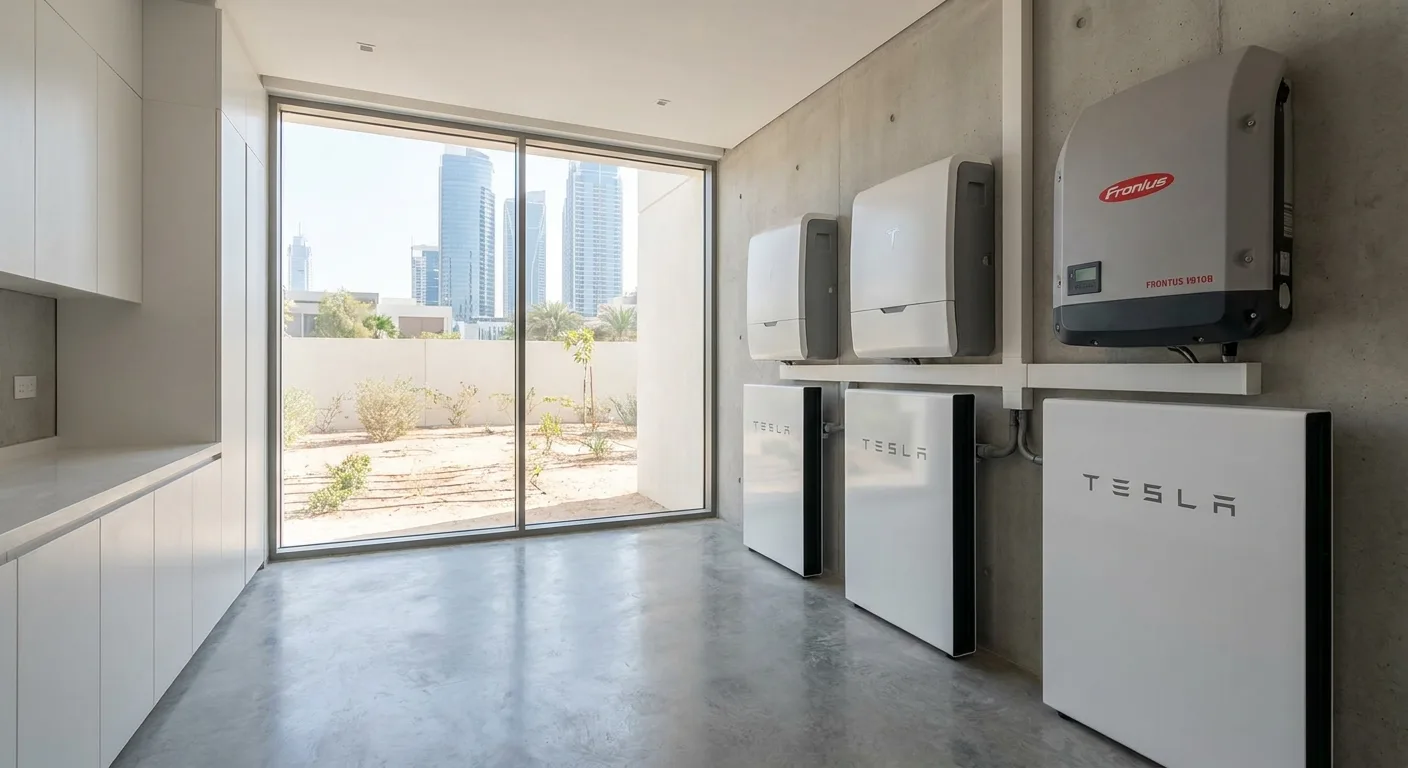
A battery still has real uses: backup during an outage, and keeping critical loads running. We set out the full numbers in our solar battery storage guide.
What We Do Not Know
The resolution sets the principle; DEWA's detailed Shams Dubai rules govern how it is applied on a bill, and we have not quoted them here. Article 9 does not mention an expiry for carried-forward units, but we would not promise that none applies. Commercial and industrial tariffs differ from the residential slabs used above. If your bill shows exports treated differently, the bill is the authority, and we would like to see it.
Frequently Asked Questions
How does DEWA credit the electricity my solar system exports?
Exported kWh are set off against the kWh you import in the same billing period (Dubai Executive Council Resolution No. 46 of 2014, Article 9.3). The netting is done in units, before the slab tariff is applied, so an exported kWh cancels an imported kWh at whatever rate that imported kWh would have been billed.
Is exported solar credited at a lower rate than I pay?
Not within a bill. Shams Dubai is net metering, not a separate export tariff: your exports reduce the number of units you are billed for. There is no fixed export rate per kWh on the residential tariff.
What happens if I export more than I import in a month?
The surplus units accrue to your DEWA account and are set off against imports in later bills (Article 9.4). DEWA does not pay money for surplus electricity (Article 9.5), so a system that exports more than the property uses over time builds up credit it cannot cash.
Do Shams Dubai credits expire?
Article 9 of the resolution says surplus units accrue to your account for set-off against later bills, and does not mention an expiry. DEWA's detailed Shams Dubai rules also apply, so check how carried-forward units appear on your own bill.
Does a battery save money under Shams Dubai?
Very little. Because a stored kWh and an exported kWh are worth the same on the bill, a battery mainly adds backup during outages. It also loses a few per cent of what it stores, so the bill effect is slightly negative.
Why does the first kWh of solar save more than the last?
Because DEWA's residential tariff is stepped by monthly consumption. Solar removes units from the top of your bill first, where they cost the most. The more of your consumption solar covers, the further down the slabs it reaches, and each extra kWh is worth less.
Sources
- Dubai Executive Council Resolution No. 46 of 2014, Dubai Legislation Portal (Article 9)
- DEWA residential slab tariff
Want the Numbers for Your Own Bill?
Send us 12 months of DEWA bills and we will size a system to your consumption, not your roof.
Get a Free Assessment